
Divorce is a big decision that changes your life. In Delhi, the legal process can be overwhelming. It involves choosing the right court and understanding how hearings work.
If you’re thinking about divorce or already going through one, knowing Delhi’s family courts is key. It helps reduce stress and makes legal decisions easier.
As a divorce lawyer in Delhi, I’ve helped with all kinds of cases. I’ll guide you through the court system and offer tips for a smart divorce in Delhi.
Where to File for Divorce in Delhi?
Many people wonder which court to file their divorce in. In Delhi, family courts handle divorce cases under the Family Courts Act, 1984. These courts deal with disputes like divorce, child custody, and alimony.
Family Courts in Delhi
Delhi has several judicial districts with their own family courts. Your case goes to the court based on where you or your spouse live.
If you’re not sure which court to go to, a divorce lawyer can help. They consider your address and other factors.
Jurisdiction Basics:
You can file for divorce where you live, your spouse lives, or where you last lived together.
For NRIs, it depends on where the marriage was solemnized or where you last lived together in India.
Choosing the right court is important. It affects how fast your case goes and your overall experience. A lawyer familiar with Delhi’s courts can help.
Types of Divorce Petitions Handled in Delhi Courts
Delhi’s family courts handle all kinds of matrimonial disputes. But not all divorces are the same. The court process varies based on your situation and the law.
1. Mutual Consent Divorce
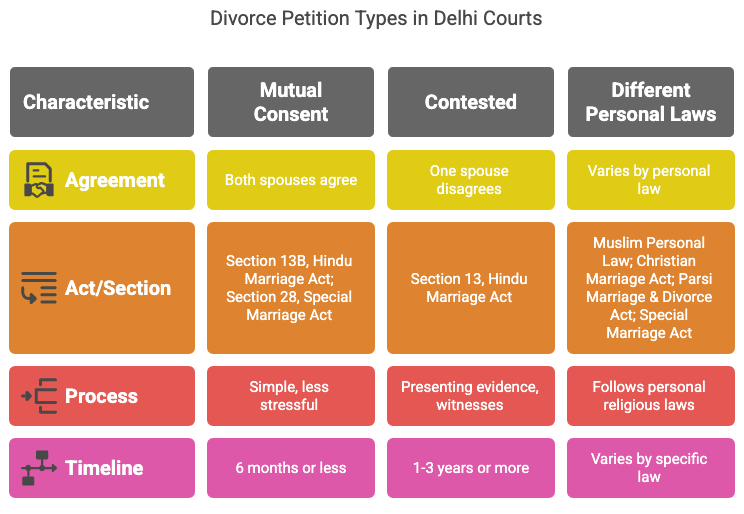
This is the simplest and least stressful divorce. Both spouses agree on key issues like property division, child custody, and alimony.
A mutual consent divorce is filed under:
Section 13B of the Hindu Marriage Act, 1955
Section 28 of the Special Marriage Act, 1954
If everything is in order and there are no disputes, Delhi courts can grant a divorce in 6 months or less.
Learn more about Mutual Consent Divorce.
2. Contested Divorce
If one spouse won’t agree or if there are issues like cruelty or adultery, the other can file for a contested divorce.
Contested divorce means:
Filing a petition under Section 13 of the Hindu Marriage Act
Presenting evidence and witnesses
A longer and more detailed hearing process
These cases can take 1 to 3 years or more. This depends on how complex the case is and the court’s workload. Learn more about Contested Divorce in Delhi.
3. Divorce Under Different Personal Laws
Delhi courts handle divorce cases under:
Muslim Personal Law (e.g., Talaq, Khula, Mubarat, Faskh)
Christian Marriage Act
Parsi Marriage & Divorce Act
Special Marriage Act (for interfaith or court marriages)
Each law has its own grounds and procedures. The court follows both personal religious laws and Indian legislation to ensure fairness and legality.
If you’re unsure which law your marriage falls under, your lawyer can clarify. They will look at your marriage certificate, religion, and how the marriage was registered.
Step-by-Step Process of Filing for Divorce in Delhi
Filing for divorce can seem scary, especially if it’s your first time in court. But once you know the process, each step gets easier. Delhi’s family courts have a clear approach, whether it’s a mutual or contested case.
Here’s how divorce proceedings usually go:
1. Consultation with a Divorce Lawyer
Your first step is a detailed talk with an experienced divorce lawyer in Delhi. This helps:
Understand your legal position
Decide if mutual consent or contested divorce is right for you
Learn about your rights on custody, maintenance, property, etc.
This is when your lawyer will check which family court your case belongs to. They will also start gathering documents.
2. Drafting and Filing the Petition
Your lawyer will draft the divorce petition based on your input and documents. They will then file it at the right Delhi family court.
The petition includes:
Details of the marriage
Grounds for divorce
Relief sought (e.g., alimony, custody)
Supporting documents and affidavits
In mutual consent cases, a joint petition is filed. In contested matters, only one party files, and the other is served a legal notice.
3. First Court Appearance and Notice to Spouse
After filing, the court sends a notice to the respondent (your spouse) to appear on a set date. Both parties must attend.
For mutual consent, this is a quick, formal hearing. For contested divorce, this is where the respondent can accept, deny, or file a counterclaim.
4. Mediation or Counseling (Court-Directed)
In most divorce cases, especially contested ones, the Delhi family court may send both parties to mediation or counseling. This is a first try at reconciliation.
This stage can help:
Avoid long litigation
Settle issues amicably
Decide custody or alimony without trial
If no settlement is reached, the case goes to trial.
5. Evidence, Witnesses, and Arguments
This is the main trial phase, where:
Both parties submit evidence (documents, messages, financials, etc.)
Witnesses are examined and cross-examined
Lawyers argue the case before the judge
This stage can take several months to over a year. This is especially true for complex or high-conflict cases.
6. Final Judgment and Divorce Decree
After reviewing all submissions, the judge delivers a verdict. If the court finds the case justified under the law, a divorce decree is granted.
You can collect a certified copy of the divorce decree for use in updating official records (passport, PAN card, bank details, etc.).
How Long Do Divorce Cases Take in Delhi?
Many people wonder, “How long will my divorce take?” The answer varies. It depends on the type of divorce, the complexity of the issues, and how well spouses cooperate.
Based on my experience with divorce cases in Delhi, here’s a general overview:
Mutual Consent Divorce Timeline
If both parties agree on all major issues—like alimony, child custody, and property—the process is usually faster.
Typical timeline:
Cooling-off period: 6 months (can sometimes be waived)
Total duration: 6 to 12 months, or even sooner with special court permission.
Note: Delhi courts sometimes waive the 6-month wait if the marriage is clearly beyond repair and settlement is already in place.
Contested Divorce Timeline
In a contested divorce, one party does not agree to the divorce or disputes issues like maintenance, custody, or allegations. This naturally takes longer due to the trial phase.
Typical timeline:
Minimum: 1 year
Average: 2–3 years
Can extend further in high-conflict or delayed cases (due to adjournments, uncooperative spouse, or evidence complications)
What Causes Delays in Divorce Cases?
One spouse avoids or delays court appearances
Incomplete documentation
Unsettled financial disputes
Delay in court scheduling or judicial backlog
Need for expert reports (e.g. psychological evaluation in child custody).
How to Speed Up the Process
Hire a lawyer experienced with Delhi’s family courts
Stay prepared with documentation
Opt for mutual consent if possible
Be clear about your expectations (custody, alimony, settlement)
Understanding the timeline helps you plan emotionally, financially, and legally. As your lawyer, my job is not only to represent you—but to help move the process forward as efficiently as the law allows.
Tips to Handle the Process Smoothly
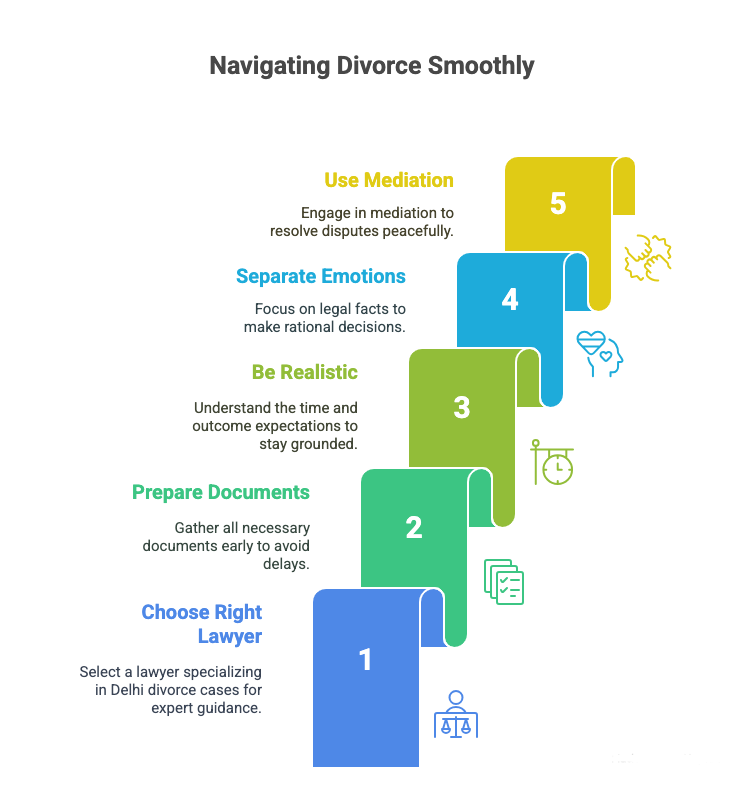
Divorce is often as much an emotional process as it is a legal one. But the way you approach the legal steps can have a huge impact on how quickly, peacefully, and fairly things move forward.
Here are some practical, experience-backed tips to help you handle divorce proceedings in Delhi with more clarity and less stress:
1. Choose the Right Lawyer — Not Just Any Lawyer
Don’t settle for someone who “also does family law.” Work with a lawyer who handles divorce cases in Delhi family courts daily. They’ll know the court procedures, how judges operate, and how to resolve disputes efficiently.
Look for someone who:
Specializes in mutual and contested divorce
Is familiar with Tis Hazari, Patiala House, Saket, and other Delhi courts
Has a track record of successful outcomes
If you’re looking for dedicated representation, you can book a consultation here.
2. Prepare Your Documents Early
The more prepared you are, the smoother the proceedings will be. Common documents include:
Marriage certificate
Address proof
Income tax returns or salary slips
Proof of separation or disputes (messages, emails, complaints).
Delays often happen because one or both parties take too long to provide the necessary paperwork.
3. Be Realistic About Time and Outcome
Many people enter the process hoping it’ll be quick or that the judge will “side with them.” But divorce takes time—even mutual consent—and contested divorces often take longer than expected.
Stay grounded in:
Legal facts, not assumptions
Fair negotiation, not revenge
Practical solutions, not winning every argument
4. Separate Emotions from Legal Decisions
Courtrooms are not ideal places for emotional battles. Being too reactive can damage your case, especially in issues like custody or maintenance.
A good lawyer will not only represent you but also help you focus on what matters: your long-term legal and personal well-being.
5. Use Mediation to Your Advantage
Delhi courts often recommend mediation before proceeding to trial. Don’t ignore it. Mediation can:
Reduce emotional toll
Speed up resolution
Avoid unpredictable judgments.
Even in high-conflict cases, I’ve seen productive outcomes through court-assisted mediation.
Divorce isn’t easy—but the process doesn’t have to be chaotic. With clear planning, expert guidance, and a calm mindset, you can move forward confidently.
Why You Need a Divorce Lawyer Familiar With Delhi Courts
When you’re facing something as personal and life-altering as divorce, the last thing you want is to feel lost in the system. While any lawyer can technically file a divorce petition, not every lawyer understands how Delhi’s family courts really work — and that difference can impact both your experience and your outcome.
Here’s why hiring a lawyer with local courtroom experience is not just helpful, but essential:
1. They Know the System Inside Out
Each Delhi family court — whether it’s Tis Hazari, Saket, Karkardooma, or Rohini — has its own procedures, pace, and even culture. Lawyers who regularly practice in these courts:
Know how each judge typically handles matters
Are familiar with how and when to file specific motions
Understand what documentation each court prefers and what might trigger delays.
2. They Handle Delays and Disruptions More Efficiently
Court dates often get rescheduled. Documents get misplaced. Judges change. Lawyers with Delhi-specific experience know how to troubleshoot these problems quickly — often before they affect your case.
This efficiency can save you months of unnecessary delay, especially in contested divorces.
3. They Have Working Relationships With Court Staff and Mediators
A lawyer who’s known and respected in Delhi courts can navigate procedural formalities faster and may even be able to guide you toward smoother mediation outcomes.
While outcomes are always based on the merits of your case, familiarity with court protocol and personnel can help avoid roadblocks that inexperienced lawyers might face.
4. They Understand Local Family Dynamics and Cultural Nuances
Delhi is a diverse city. Whether you’re from a conservative family, an interfaith marriage, or part of the NRI community — a local lawyer who understands these nuances can represent your interests with more empathy and precision.
They know the questions judges are likely to ask, and how to prepare you for them — not just legally, but mentally.
In short, hiring a lawyer who regularly handles divorce cases in Delhi’s family courts doesn’t just increase your chances of success — it reduces your stress and gives you a true partner in the process.
Frequently Asked Questions (FAQs)
1. Which family court should I go to for a divorce in Delhi?
It depends on where you or your spouse live. Delhi has courts in Tis Hazari, Patiala House, and others. A lawyer can help find the right one for your case.
2. Can I file for divorce online in Delhi?
Some initial steps are now online through e-Courts. But, you still need to go to court and submit documents. Online help is getting better, but a lawyer is still key.
3. How long does a mutual consent divorce take in Delhi?
A mutual consent divorce usually takes 6 to 12 months. This depends on the court’s schedule and if the 6-month wait is skipped. If everything is agreed, it might be faster.
4. What if my spouse doesn’t attend the court hearings?
If your spouse ignores court notices, the judge can still decide without them. This is if you prove you served them properly. The court can then grant the divorce based on your evidence.
5. Do I need to appear in person for a divorce case in Delhi?
Yes, you usually need to be there in person. This is for things like giving testimony or settling disputes. But, for NRIs or special cases, courts might allow video calls or a power of attorney.
6. What happens if we decide to reconcile during the divorce process?
You can ask the court to stop or dismiss the case at any time before the final decision. Courts often suggest mediation early on to see if you can work things out.